

The Resignation That Changed Everything
It was 2:15 PM on a Tuesday in rainy Seattle when I finally clicked "Send."
The email was brief. It didn’t detail the three years of burnout, the 60-hour workweeks, or the fact that I had spent the last six months staring at my Jira tickets with a hollow sense of dread. It simply stated that I was resigning from my position as a Senior Software Engineer, effective immediately.
My salary was $175,000. My 401(k) was robust. My health insurance was world-class. To my parents, I was the success story of the family. To my boss, I was a reliable "resource." But to myself, I was a ghost in a high-rise, trading the best years of my life for RSUs and free kombucha in the breakroom.
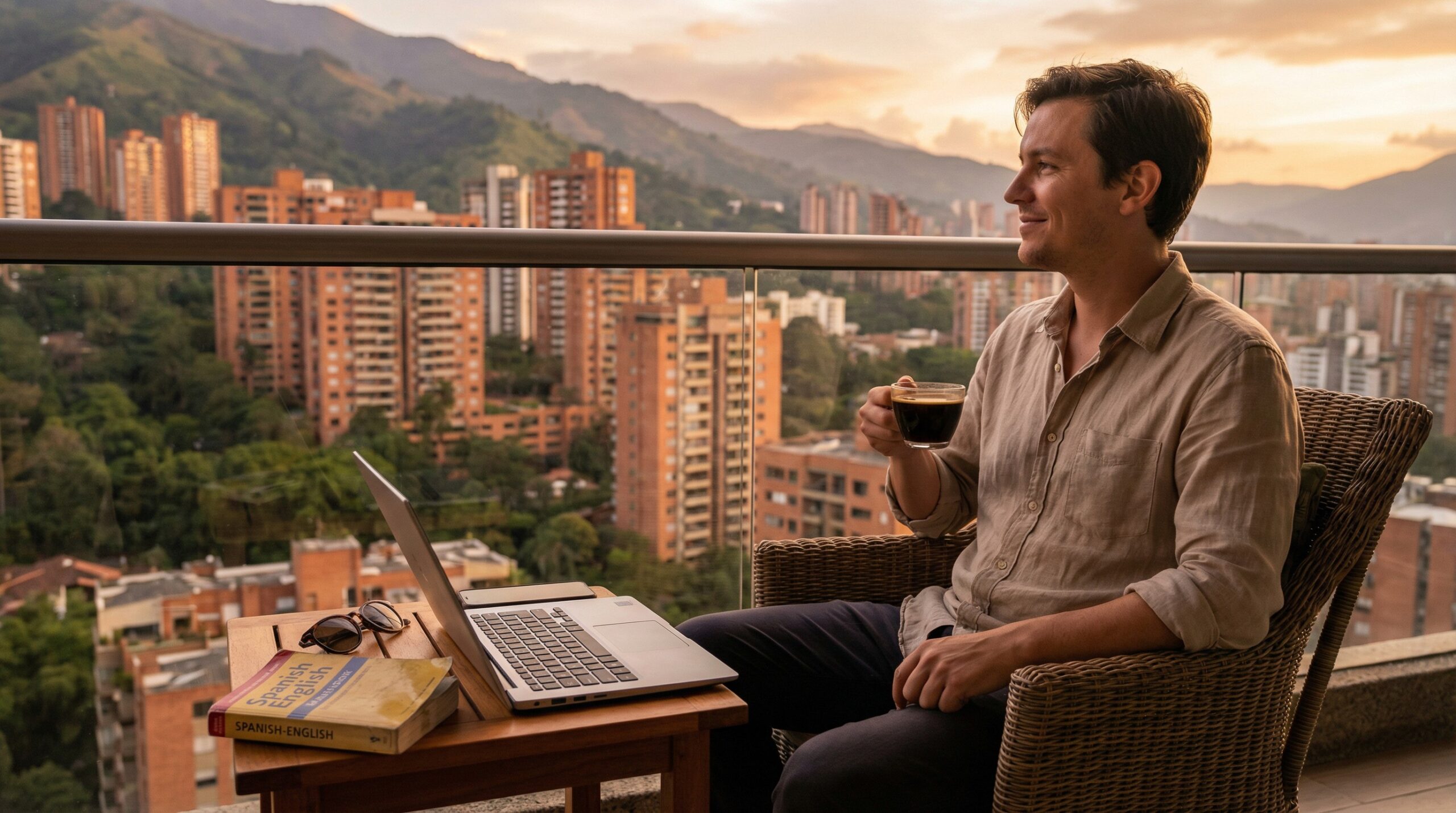
An hour later, I was packing a single Osprey 40L backpack. My destination wasn’t another tech hub like Austin or San Francisco. It was Medellín, Colombia—the "City of Eternal Spring." And as I stand on my balcony in the Laureles neighborhood today, looking out at the lush, green Andean peaks that ring the city, I can honestly say: I am never looking back.
The Golden Handcuffs of 2024–2025
For years, I believed the lie that "making it" in tech meant sacrificing everything else. Between 2024 and 2025, my life was a blur of Zoom calls, stand-ups, and the relentless pressure of "deploy-or-die" culture. I was living in a $3,200-a-month studio apartment that I only used for sleeping and the occasional depressed scroll through Uber Eats.
The "Golden Handcuffs" are real. Every time I thought about leaving, I’d look at my vesting schedule. Just six more months, I’d tell myself. Just wait until the next bonus cycle. But money becomes an abstract number when you don’t have the time or the mental health to enjoy it. I was 29 years old, and my resting heart rate was that of a man twice my age. I had "unlimited" PTO that I was too afraid to use, and a social life that consisted entirely of Slack emojis.
The breaking point didn't come in a dramatic explosion. It came during a 10:00 PM "emergency" bug fix on a Friday night. As I sat alone in my dark living room, illuminated only by the blue light of three monitors, I realized I hadn't seen the sun in three days. I was building software that helped people click more ads, while I was forgetting how to be a person.
Why Medellín?
I spent weeks researching where to go. I wanted a place that had a high quality of life, reliable fiber-optic internet, and a culture that valued people over productivity. Medellín kept appearing at the top of every list. In 2026, it has officially matured from a "nomad secret" to a global hub for remote talent. But unlike Lisbon or Mexico City, which have seen prices skyrocket to near-US levels, Medellín still offered a "Middle Class Plus" lifestyle for a fraction of what I was spending in Seattle.
Moreover, Colombia’s Digital Nomad Visa (V Nómadas Digitales) had become one of the easiest in the world to obtain. For a software engineer with a remote contract or enough savings, you could live and work in the country legally for up to two years. It felt like the universe was giving me an exit ramp.

The First 48 Hours: Culture Shock and "No Dar Papaya"
Stepping out of José María Córdova International Airport was a sensory overload. The air was thin, crisp, and smelled of eucalyptus and woodsmoke. The taxi ride down the winding mountain road into the Aburrá Valley felt like descending into a sea of orange lights.
My first two days were a lesson in slowing down. In the US, if you order a coffee, you expect it in 90 seconds. At Pergamino Café in El Poblado, I waited fifteen minutes for a pour-over. I started to get annoyed, checking my watch, before I realized: I have nowhere to be. I watched the people around me. They weren't buried in their phones; they were talking, laughing, and actually tasting their food.
I also had to learn the local golden rule: "No dar papaya." It literally means "don't give papaya," but it’s a metaphor for "don't make yourself a target." In 2026, Medellín is significantly safer than its dark past suggests, but it still demands respect. You don't walk around with your iPhone 17 Pro Max out in the open, and you stay aware of your surroundings. It’s a small price to pay for the vibrancy of the city.

The Financial Reality: Seattle vs. Medellín
Readers always ask about the numbers. Let’s be transparent. In Seattle, I was "rich" but felt "broke." In Medellín, I live like a king on less than half of my previous tax bill.
| Expense | Seattle (USD) | Medellín (USD) |
| Rent | $3,200 (1BR Studio) | $1,100 (Luxury Penthouse) |
| Groceries | $600 | $250 |
| Dining Out | $800 | $300 |
| Health Insurance | $450 (High Deductible) | $90 (Private Policy) |
| Internet/Utilities | $250 | $80 |
| Total Monthly | $5,300 | $1,820 |
I transitioned from a high-stress "Staff" role to a part-time consulting gig that pays me about $6,000 a month. In the US, that would be a tight budget for a family; here, it allows me to save 60% of my income while dining at world-class restaurants like El Cielo and taking weekend trips to the colorful town of Guatapé.
A Day in the Life: From Jira to "Jugo de Lulo"
My life now looks nothing like the grey cubicle existence I left behind.
I wake up at 7:00 AM without an alarm. I spend an hour on my balcony with a cup of local coffee, watching the clouds roll over the mountains. By 9:00 AM, I’m at a coworking space like Semilla in Laureles. The community here is electric. I’m surrounded by entrepreneurs, writers, and fellow engineers from Brazil, France, and Canada. We aren't competing for promotions; we're sharing tips on where to find the best bandeja paisa.
I work until 2:00 PM. Because Medellín is in the same time zone as the US East Coast (EST), I can finish my work while my American clients are just getting back from lunch. My afternoons are spent at a Brazilian Jiu-Jitsu gym or taking intensive Spanish lessons.
In the evenings, the city comes alive. The "Provenza" area is a pedestrian-only paradise of neon lights, reggaeton, and some of the best fusion food in South America. I’ve made more genuine friends in six months here than I did in six years in Seattle. There is a "warmth" to the Paisas (people from Medellín) that is infectious. They value family and leisure in a way that makes the American "hustle culture" look like a collective fever dream.

The Hard Truths
I won't lie and say it's all sunshine and salsa dancing. Leaving your home country is a grieving process. I miss my sister’s kids. I miss the reliability of US infrastructure. Occasionally, the power goes out during a tropical thunderstorm, or the bureaucracy of a Colombian bank makes me want to scream.
There is also the "Ethical Nomad" dilemma. As more of us arrive with our USD salaries, we are driving up rents in neighborhoods like El Poblado. I make it a point to spend my money at local businesses rather than international chains, and I’m actively learning the language so I can be a neighbor, not just a guest.
Why I'm Not Looking Back

People ask me if I’m worried about my career trajectory. "Won't you fall behind the AI curve?" "What about your resume gap?"
My answer is simple: I’ve never been a better engineer than I am right now. Why? Because I’m finally rested. My brain has the "RAM" to think creatively again. I’m working on projects I actually care about, and I’m doing it from a place of joy rather than fear.
The most profound change, however, isn't in my bank account or my GitHub contributions. It’s in my mirror. The dark circles under my eyes are gone. I’ve lost 15 pounds just by walking the hills of the city and eating fresh, non-processed food. I feel like I’ve finally "logged in" to my own life.
If you’re sitting at your desk right now, staring at a spreadsheet and wondering if this is all there is—take it from someone who was exactly where you are. The world is much larger than your office park. The "Golden Handcuffs" only work if you keep your hands closed.
Medellín didn't just give me a lower cost of living. It gave me my time back. And in 2026, time is the only currency that truly matters.