

When it comes to iconic statues, many minds immediately dart to colossal figures like the Statue of Liberty in New York or Christ the Redeemer in Rio. However, scattered across the globe, away from the hustle and bustle of capital cities, stand statues equally steeped in history, culture, and awe-inspiring artistry. These sculptures, often overshadowed by their famous urban counterparts, hold stories and significance that resonate deeply with locals and travelers alike. Here's a look at 20 such statues, each with its own unique tale to tell.
1. The Little Mermaid (Copenhagen's most photographed lady)

Perched on a rock at the Langelinie promenade in Copenhagen, Denmark, The Little Mermaid statue is a bronze beauty gazing longingly towards the shore. Inspired by Hans Christian Andersen's fairy tale, this statue was unveiled in 1913 and has since become one of Denmark's most recognized symbols. Despite its relatively small size, the sculpture attracts millions of visitors every year, drawn by its poignant representation of the mermaid's unfulfilled love. The statue has endured vandalism over the years but remains an enduring symbol of both Copenhagen and the timeless tales of Andersen. Its allure lies not just in its artistry but in the emotional depth it symbolizes.
2. Moai Statues (Easter Island's ancient enigmas)

The Moai statues of Easter Island, a remote Chilean territory in the Pacific Ocean, are among the world's most intriguing archaeological wonders. These monumental statues, carved by the Rapa Nui people between the 13th and 16th centuries, are famed for their oversized heads and deep, brooding eyes. There are over 900 Moai statues scattered across the island, with many still perched on their original stone platforms called ahus. Theories about their creation and transportation methods abound, yet much about these statues remains shrouded in mystery. They stand as silent guardians of an isolated island, embodying the ingenuity and determination of their creators.
3. Christ of the Abyss (Underwater serenity in Italy)

Submerged in the Mediterranean Sea off the coast of San Fruttuoso in Italy, the Christ of the Abyss is a submerged bronze statue of Jesus Christ. Placed about 17 meters underwater in 1954, it offers a serene, silent watch over the bay. The statue, with arms outstretched towards the surface, creates a powerful image of peace and protection. Divers and snorkelers flock to this spot, not only for the rich marine life but to witness the ethereal presence of this underwater guardian. The Christ of the Abyss has inspired similar statues in waters around the world, but none match the original's haunting beauty and tranquil setting.
4. Manneken Pis (Brussels' cheeky little boy)

In the heart of Brussels, Belgium, the Manneken Pis statue whimsically captures the irreverent spirit of the city. This small bronze sculpture depicts a little boy in the act of urinating into the fountain's basin. Originating from the 17th century, the statue has become a beloved symbol of Brussels, embodying the city's humor and independence. The Manneken Pis is often dressed in costumes from a collection that spans hundreds of outfits, reflecting various international cultures, professions, and festivities. This cheeky statue, despite its size, draws visitors from around the globe, all eager to see the famous boy and his ever-changing wardrobe.
5. The Motherland Calls (A towering tribute in Russia)

Standing tall on the banks of the Volga River in Volgograd, Russia, The Motherland Calls is a staggering embodiment of courage and resilience. Erected in 1967 to commemorate the Battle of Stalingrad, this statue is one of the tallest in the world, with the figure itself reaching 85 meters in height. The sculpture depicts a woman stepping forward with a raised sword, calling her children to defend their homeland against invasion. The Motherland Calls is not only a remarkable feat of engineering but also a powerful symbol of the sacrifices made during one of World War II's most brutal battles. Its monumental size and dynamic posture make it an unforgettable sight and a poignant reminder of Russia's storied past.
6. Genghis Khan Equestrian Statue (Mongolia's towering tribute)

East of Ulaanbaatar, Mongolia, on the bank of the Tuul River, stands the Genghis Khan Equestrian Statue, a stainless steel colossus honoring the legendary founder of the Mongol Empire. At 40 meters tall, it is the world's largest equestrian statue, depicting Genghis Khan with a fierce expression, holding a golden whip. This statue, part of a larger complex intended to celebrate Mongolian culture and history, was completed in 2008. Visitors can ascend to a viewing platform in the horse's head, offering sweeping views of the surrounding steppe and the imposing figure of Khan himself. This statue not only commemorates a pivotal figure in world history but also serves as a proud symbol of Mongolia's heritage and resilience.
7. The Kelpies (Scotland's mythical water horses)

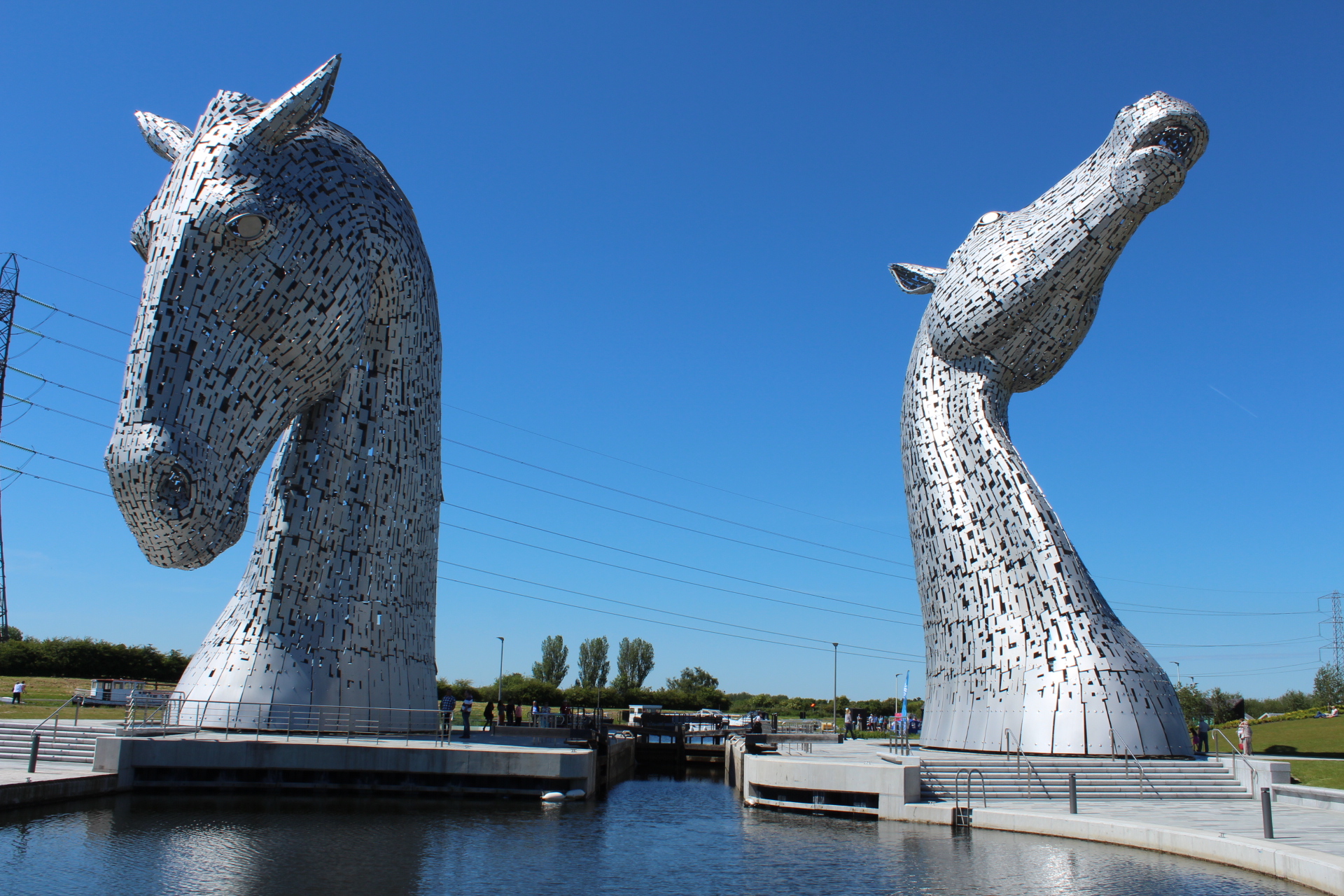
In Falkirk, Scotland, The Kelpies stand as a magnificent tribute to the country's canal heritage and its mythological creatures. These two 30-meter-high horse head sculptures, made of stainless steel, tower over the Forth and Clyde Canal, drawing inspiration from the shape-shifting water spirits of Scottish folklore. Designed by artist Andy Scott and unveiled in 2013, The Kelpies are the largest equine sculptures in the world. They represent the transformational and enduring spirit of Scotland, its people, and the natural beauty of its lands. Visiting The Kelpies, especially at night when they are illuminated, offers a breathtaking experience of art blending with mythology.
8. Terrace of the Lions (Delos' ancient guardians)

The Terrace of the Lions on the sacred island of Delos, Greece, presents a row of majestic marble lions guarding the sacred way. Dating back to the 7th century BC, these lions were dedicated to Apollo by the people of Naxos, symbolizing protection for the sanctuary and its worshippers. Although originally there were more, only a handful of these weathered lions remain today, standing watch over the ruins. Their silent, stone gazes offer a glimpse into the rich religious and cultural life of ancient Greece. The Terrace of the Lions is a must-visit for anyone fascinated by history and the enduring legacy of ancient civilizations.
9. The Big Buddha (Thailand's serene giant)

Perched atop Nakkerd Hill near Phuket, Thailand, the Big Buddha is a towering figure of serenity overlooking the island. This 45-meter-tall statue, made of white Burmese marble, shines brightly under the Thai sun, visible from miles around. Completed in 2008, it not only serves as a landmark but also as a symbol of peace and mindfulness. Visitors can enjoy panoramic views of Phuket, the Andaman Sea, and the surrounding green hills from the statue's base. The Big Buddha's tranquil presence and the gentle sound of dharma music create a soothing atmosphere that resonates with people from all walks of life.
10. Hercules Monument (Germany's colossal cascading statue)

Overlooking the city of Kassel, Germany, the Hercules Monument is an awe-inspiring statue and architectural marvel set atop the Wilhelmshöhe Hill. This massive structure, representing the Roman hero Hercules, was completed in the early 18th century and is known for its octagonal base and towering pyramid that leads to the statue itself. The monument is the starting point of a water display that cascades down the hillside, culminating in a grand fountain at the base. This UNESCO World Heritage site not only celebrates the Herculean strength and endurance but also the ingenuity of Baroque art and design. The Hercules Monument, with its impressive water features and commanding view, is a testament to human creativity and determination.
11. The Merlion (Singapore's mythical emblem)

Singapore's Merlion statue, with the head of a lion and the body of a fish, stands as a mythical symbol representing the city-state's origins as a fishing village and its traditional Malay name, Singapura, meaning "lion city." Located in the Merlion Park near Marina Bay, the statue spouts water from its mouth, becoming one of Singapore's most recognizable landmarks. This 8.6-meter-tall figure was unveiled in 1972 and has since become a popular spot for photos and a must-visit for tourists. The Merlion embodies Singapore's humble beginnings and its transformation into a bustling metropolis. It serves as a reminder of the country's rich heritage and its dynamic future.
12. David (Michelangelo's Renaissance masterpiece)

Michelangelo's David, standing in the Galleria dell'Accademia in Florence, Italy, is a Renaissance masterpiece that captures the beauty of human form and the spirit of the era. Carved from a single block of marble, this statue represents the biblical hero David, poised for battle with Goliath. Completed in 1504, the sculpture is renowned for its detailed anatomy and the lifelike quality Michelangelo imbued in the marble. Standing over 5 meters tall, David attracts millions of visitors each year, who come to admire the skill and emotion captured in stone. This iconic statue not only showcases the genius of Michelangelo but also symbolizes the power of human creativity and intellect.
13. The Thinker (Rodin's contemplative figure)

Auguste Rodin's The Thinker is a bronze statue that has come to represent philosophical pondering and artistic introspection. Originally part of a larger work called The Gates of Hell, The Thinker depicts a man in deep thought, his physical strength juxtaposed with a moment of intellectual engagement. Versions of this famous sculpture can be found in museums around the world, but the original sits outside the Rodin Museum in Paris. Despite its global presence, each iteration of The Thinker invites viewers to pause and reflect, embodying the universal quest for understanding. Rodin's masterpiece continues to inspire and provoke thought, transcending the boundaries of time and culture.
14. The Statue of Liberty (A towering gift of freedom)

Though often associated with New York City, the Statue of Liberty actually resides on Liberty Island, just outside the city's jurisdiction, making it a fitting addition to this list. This colossal neoclassical sculpture was a gift from France to the United States, dedicated in 1886. Representing Libertas, the Roman goddess of freedom, she holds a torch above her head and a tablet inscribed with the date of the American Declaration of Independence. The statue has become an iconic symbol of freedom and democracy around the world. Visiting this monumental figure offers a poignant reminder of the enduring values it represents.
15. The Sphinx of Giza (Egypt's timeless guardian)

Nestled on the Giza Plateau near the Great Pyramids, the Sphinx of Giza is one of Egypt's most enduring mysteries. This colossal limestone statue, with the body of a lion and the head of a human, is believed to represent Pharaoh Khafre, who ruled during the 4th dynasty. Dating back to around 2500 BC, the Sphinx has fascinated archaeologists and travelers alike with its enigmatic smile and imposing presence. Despite the nose being missing, the face of the Sphinx continues to captivate those who gaze upon it, symbolizing the strength and wisdom of ancient Egypt. Its age and the mysteries surrounding its construction add to the allure of this ancient guardian.
16. The Guardian of the Highlands (Scotland's modern warrior)

In the heart of the Scottish Highlands, near the village of Drumnadrochit, stands The Guardian of the Highlands. This impressive sculpture, also known as the commando memorial, pays tribute to the British Commandos who trained in this area during World War II. The statue portrays a group of soldiers looking out over the landscape, a poignant reminder of the sacrifices made for freedom. Unveiled in 1952, it has become a place of pilgrimage for veterans, their families, and those wishing to honor the bravery of these soldiers. Surrounded by the stunning natural beauty of the Highlands, the memorial offers a moment of reflection on the cost of peace.
17. Gundam Statue (Tokyo's towering robot)

In the futuristic city of Tokyo, Japan, stands a life-size statue of the Gundam robot, a testament to the country's love for anime and robotics. Located in the Odaiba district, this 18-meter-tall representation of the RX-78-2 Gundam model from the beloved Gundam series draws fans from across the globe. The statue not only showcases impressive design and engineering but also lights up and moves, offering a thrilling experience for visitors. Unveiled in 2017, it celebrates the intersection of art, culture, and technology unique to Japan. The Gundam statue is a must-see for anime enthusiasts and anyone fascinated by the blend of tradition and innovation in Japanese culture.
18. The Freedom Sculpture (Los Angeles' tribute to cultural diversity)

Los Angeles, California, is home to The Freedom Sculpture, a modern monument celebrating the city's diverse cultural heritage. This stainless steel sculpture, inspired by the ancient Persian artifact known as the Cyrus Cylinder, symbolizes the principles of freedom, respect, and tolerance. Unveiled in 2017, it was crowd-funded by people from over 50 countries, reflecting the global appreciation for these universal values. Located on Santa Monica Boulevard, it has quickly become a beacon for the community, drawing visitors who seek inspiration in its message and design. The Freedom Sculpture stands as a testament to the power of art to unite people across different backgrounds and beliefs.
19. The Scallop (Aldeburgh's tribute to Benjamin Britten)

On the pebbled beach of Aldeburgh, Suffolk, stands The Scallop, a striking steel sculpture dedicated to the renowned British composer Benjamin Britten. Unveiled in 2003, this 4-meter-high artwork, created by Maggi Hambling, features the words "I hear those voices that will not be drowned" from Britten's opera "Peter Grimes." The Scallop serves as both a memorial and an interactive piece of art, inviting visitors to sit and gaze out at the sea that inspired much of Britten's work. It has sparked debate and conversation, embodying the spirit of creativity and controversy alike. This seaside sculpture not only honors a musical genius but also enhances the natural beauty of the Suffolk coast.
20. Pegasus and Dragon (A mythical battle in Florida)

In the heart of Florida, at the Gulfstream Park in Hallandale Beach, stands an epic sculpture depicting a battle between a giant Pegasus and a fearsome dragon. This massive bronze statue, one of the largest in the world, towers at 33 meters in height and spans an impressive 33 meters in width. Unveiled in 2014, it symbolizes the struggle between good and evil, drawing on mythology to inspire awe and wonder. Visitors to Gulfstream Park are greeted by this dramatic scene, set against the backdrop of palm trees and blue skies. The Pegasus and Dragon sculpture not only adds a touch of fantasy to the Florida landscape but also stands as a bold statement of art's power to ignite the imagination.
This article was written by a human and edited with AI Assistance