
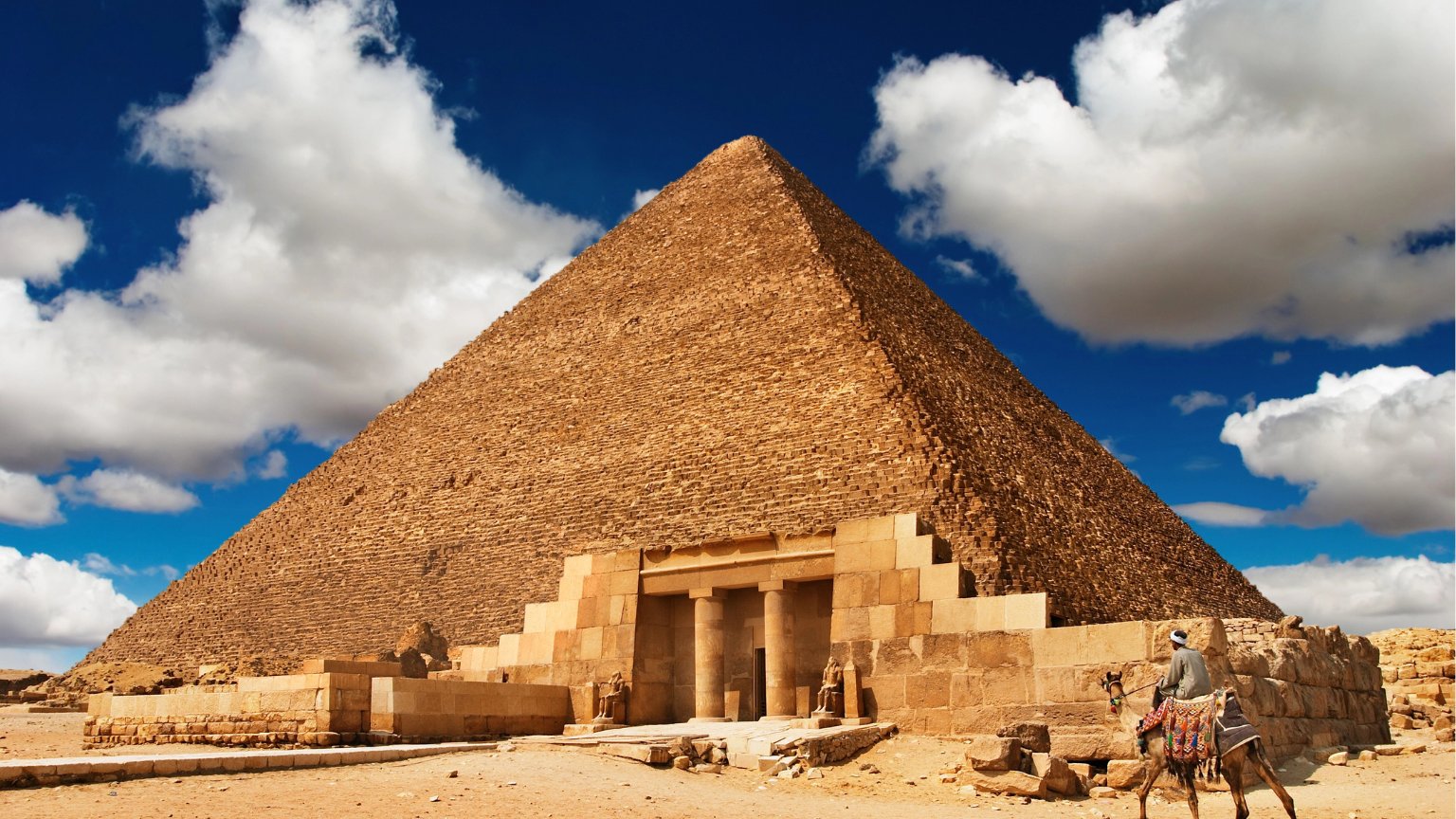

The pyramids of Giza have been studied for centuries, yet they continue to surprise researchers. Despite their age and the countless expeditions that have examined them, scientists are still uncovering new details hidden inside their massive stone walls. The latest discovery suggests that one of the pyramids may contain a secret entrance that has gone unnoticed for more than four thousand years.
The pyramid at the center of this research is the Pyramid of Menkaure, the smallest of the three main pyramids on the Giza plateau. Built around 2490 BC, it was constructed for Pharaoh Menkaure and is known for its distinctive granite casing stones at the base. While it may not match the size of the Great Pyramid, it has long puzzled archaeologists due to its unusual design choices and incomplete outer casing.
What the Researchers Found
A team of scientists from Cairo University and the Technical University of Munich used modern scanning technologies to study the pyramid without drilling or excavation. These methods included ground penetrating radar, electrical resistivity scans, and ultrasonic imaging. Together, they allowed researchers to map what lies behind the stone blocks with surprising accuracy.
The scans revealed two previously unknown voids located just behind the eastern face of the pyramid. These empty spaces appear to be air filled and positioned in a way that does not match known structural features like relieving chambers or construction gaps. Their placement immediately raised questions about their purpose.
One of the most intriguing details is the surface of the stone blocks covering this area. The granite here is unusually smooth and carefully polished, similar to the finish seen around known entrances in other pyramids. This kind of craftsmanship was typically reserved for areas meant to be seen or accessed, not for purely structural walls.
Why a Second Entrance Would Be a Big Deal
Most pyramids have a single known entrance, almost always located on the north side. This tradition appears to be tied to ancient Egyptian beliefs about the afterlife and the stars. Finding evidence of an entrance on the eastern side would challenge long held assumptions about pyramid design and ritual planning.
If confirmed, this could mean the Pyramid of Menkaure was intended to be accessed in more than one way. The eastern side of pyramids was often associated with rebirth and the rising sun, which opens up new possibilities about the symbolic meaning of the structure. Some researchers speculate that a secondary entrance could have been ceremonial, restricted, or sealed intentionally soon after construction.
It also raises the possibility that additional chambers or passageways remain undiscovered. While the voids themselves are not large, they could connect to corridors deeper within the pyramid or serve as transitional spaces designed to mislead tomb robbers.
How This Fits Into Recent Discoveries
This finding follows a growing trend of discoveries made using non invasive technology. In recent years, scientists have used cosmic ray imaging to identify hidden corridors and chambers inside the Great Pyramid of Khufu. These tools have proven that even structures studied for generations can still hold major surprises.
The Pyramid of Menkaure has received less attention historically compared to its larger neighbors, which makes this discovery even more interesting. It suggests that smaller pyramids may have been just as complex and carefully planned as the Great Pyramid, even if they appear simpler on the surface.
What Happens Next
For now, researchers are proceeding carefully. The presence of voids does not automatically confirm an entrance, but it strongly suggests intentional design rather than random construction gaps. The next step involves additional scanning to determine whether these spaces connect to other internal features.
Any physical exploration would require approval from Egyptian authorities and would be carried out with extreme caution. Preserving the integrity of the pyramid is a top priority, and invasive methods are typically avoided unless there is strong evidence of significant findings.
Why It Matters
Discoveries like this remind us that ancient civilizations were more sophisticated than we often give them credit for. The builders of the pyramids worked with remarkable precision, advanced planning, and a deep understanding of symbolism. Each new finding helps historians piece together how these monuments were designed, used, and protected.
Even after thousands of years, the pyramids still have stories left to tell. With modern technology and careful research, we are finally starting to hear them.
This article was written by Will and edited with AI assistance.