
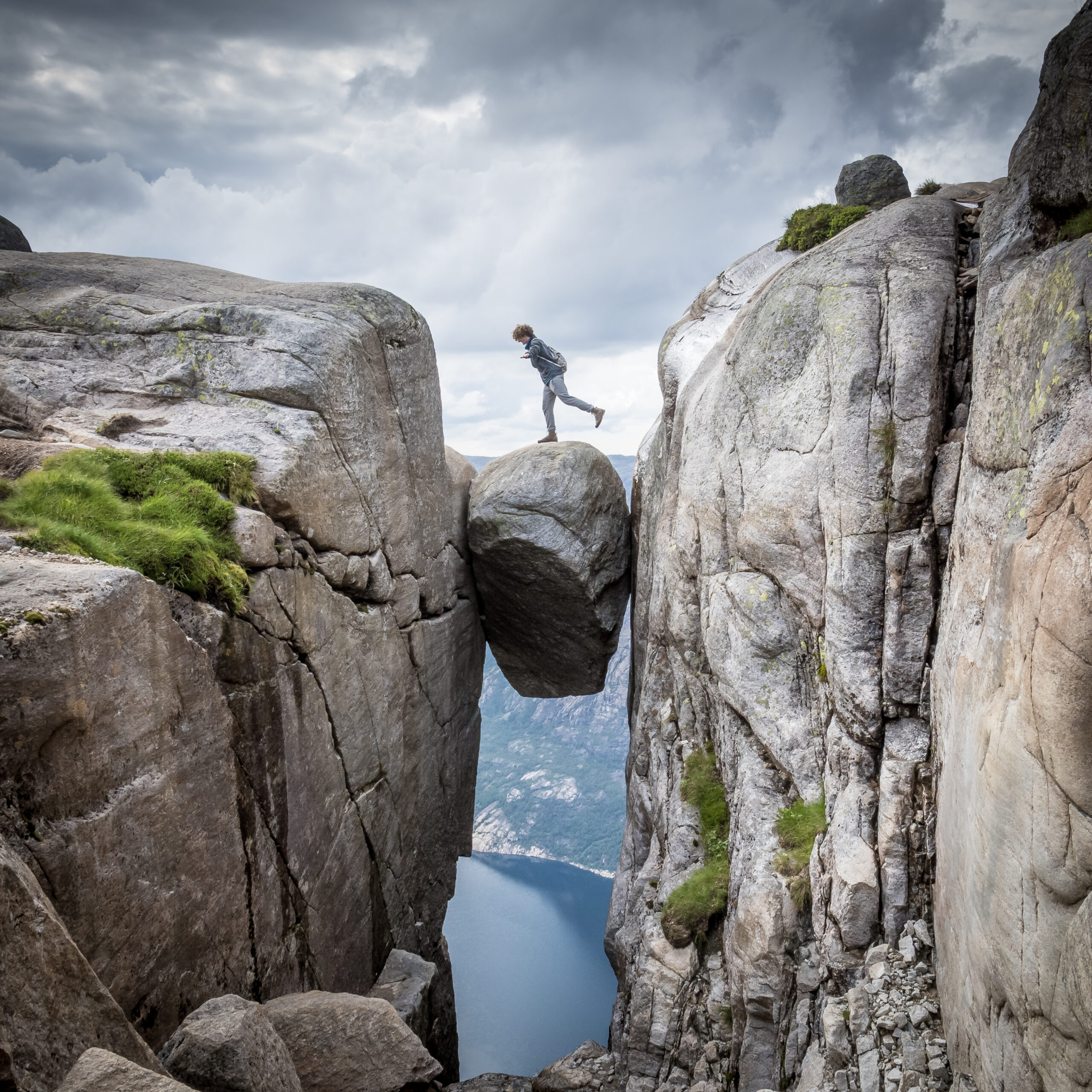

Imagine giant stones, perched precariously on cliff edges as if defying gravity itself. These natural wonders, found around the globe, offer a glimpse into the Earth's ancient geological processes. They captivate the imagination, challenging our understanding of balance and endurance. Each boulder tells a story of time, erosion, and the raw power of nature.
1. Brimham Rocks (England's gravity-defying sculptures)

In the heart of North Yorkshire, the Brimham Rocks stand as natural marvels sculpted by Mother Nature over centuries. These formations, some as high as 30 feet, teeter on tiny bases that seem too frail to support their massive weight. The most famous among them, the Idol Rock, balances on a shockingly small footprint, challenging the wind and weather. Local legends and myths weave through the history of these rocks, as ancient as 320 million years. Visitors flock here not just for the climbing, but to marvel at how these stones have defied gravity for millennia.
2. Kjeragbolten (A boulder trapped between two cliffs)

Nestled in the mountains of Rogaland county, Norway, the Kjeragbolten is a breathtaking sight. This large boulder is wedged firmly in a crevasse on the edge of the Kjerag mountain, suspended above a 984-meter deep abyss. The stone, a glacial deposit, has become a popular spot for daredevil tourists seeking the thrill of standing atop it, with nothing but air beneath them. Despite its perilous position, the boulder remains a stable platform, having withstood the elements for thousands of years. It embodies the extreme beauty and danger of nature in one snapshot.
3. Balancing Rock (The legendary monolith of Nova Scotia)

On the rugged shores of Nova Scotia, Canada, the Balancing Rock stands as a testament to the relentless force of glacial activity. This towering column of basalt, 20 feet tall, defies logic by balancing perfectly on a narrow base. The rock's precarious position is even more impressive considering the harsh weather conditions it endures, including heavy winds and storms. Visitors can view this geological oddity after a trek down a 235-step staircase, leading to one of the most photographed locations in the region. Its continued existence baffles scientists and enchants visitors from around the world.
4. Chiremba Balancing Rocks (Zimbabwe's natural wonders)

In the midst of Zimbabwe's landscape lie the Chiremba Balancing Rocks, a series of natural rock formations near Harare. These rocks have become emblematic of the country, even appearing on the 100 trillion Zimbabwean dollar banknote. They are a stunning example of how erosion can create art, with rocks precariously perched on top of one another in seemingly impossible arrangements. The formations have been shaped over millions of years, standing resilient against the elements. They offer a spectacular sight, symbolizing the balance between man and nature, encouraging conservation and respect for the natural world.
5. Devil's Marbles (Australia's ancient playground)

The Devil's Marbles, or Karlu Karlu, as they are known to the traditional owners, are an iconic Australian landmark. Located in the Northern Territory, these gigantic granite boulders, some split perfectly in half, appear to play a game of balance. They vary in size, with some reaching up to six meters in diameter, and stand on wide, flat plains, making their balancing act even more dramatic against the vast Australian outback. These rocks hold great cultural significance for the Indigenous people and are protected within a reserve. Their formation is the result of millions of years of erosion, leaving behind hard granite boulders that the elements continue to shape.
6. Mushroom Rock State Park (A quirky landscape in Kansas)

In the heart of the United States, Kansas boasts its own peculiar set of balancing rocks at Mushroom Rock State Park. These unique formations resemble mushrooms, hence the name, with slender stems supporting disproportionately large caps. They're a result of differential erosion, where the softer rock erodes away quicker than the harder rock above. This park, although small, offers visitors a chance to wander among these geological curiosities, some of which have been standing for millions of years. It's a reminder that even in the most unexpected places, nature has a way of leaving its mark.
7. Golden Rock (Myanmar's sacred boulder)

The Golden Rock, or Kyaiktiyo Pagoda, is one of Myanmar's most sacred sites. Perched on the edge of a cliff, this giant boulder, covered in gold leaf and topped with a stupa, seems to defy gravity. According to legend, the rock maintains its balance due to a single strand of the Buddha's hair placed underneath it. Pilgrims from all over the world come to marvel at this spectacle, often adding their own gold leaf to its surface. The combination of spiritual significance and the sheer physical improbability of its balancing act makes the Golden Rock a unique pilgrimage site.
8. Precariously Balanced Rocks (California's earthquake sentinels)

In various locations across California, precariously balanced rocks serve as natural indicators of seismic activity. These formations, which have remained undisturbed by earthquakes over thousands of years, provide clues to geologists about the strength and frequency of past tremors. By studying these rocks, scientists can predict future earthquake activity, making them invaluable to the region's seismic research. The rocks themselves, often found in desert areas, offer a striking visual contrast to the soft, eroded landscapes around them. Their existence challenges our understanding of balance and stability in a constantly changing world.
9. The Cheesewring (England's granite hat stack)

On the windswept moors of Cornwall, England, stands the Cheesewring, a natural rock formation that resembles a stack of giant, uneven discs. This curious pile of stones, the result of weathering and erosion, defies the fierce Atlantic winds that sweep across the landscape. Folklore tells of a wrestling match between a man and a giant to determine whether the region would be inhabited by humans or giants, with the Cheesewring as the prize. Though only about 10 feet high, its precarious stack captures the imagination, symbolizing the balance between legend and the natural world. The Cheesewring not only offers a glimpse into Cornwall's rich mythology but also showcases the enduring power of natural forces.
10. The Suspended Stone of Tandil (Argentina's lost wonder)

In Tandil, Argentina, there once stood the Piedra Movediza, a large stone that balanced so finely on the edge of a cliff it could be rocked with a push. Though it tragically fell in 1912, the Suspended Stone of Tandil remains an iconic story in Argentina's history of natural wonders. Efforts to replace the original with a replica in 2007 have allowed new generations to appreciate the marvel of balancing rocks, albeit in a different form. This tale of the Suspended Stone underscores the delicate balance between nature's grandeur and its fragility. It serves as a poignant reminder of the temporary nature of even the most seemingly permanent natural landmarks.
This article was written by a human and edited with AI Assistance